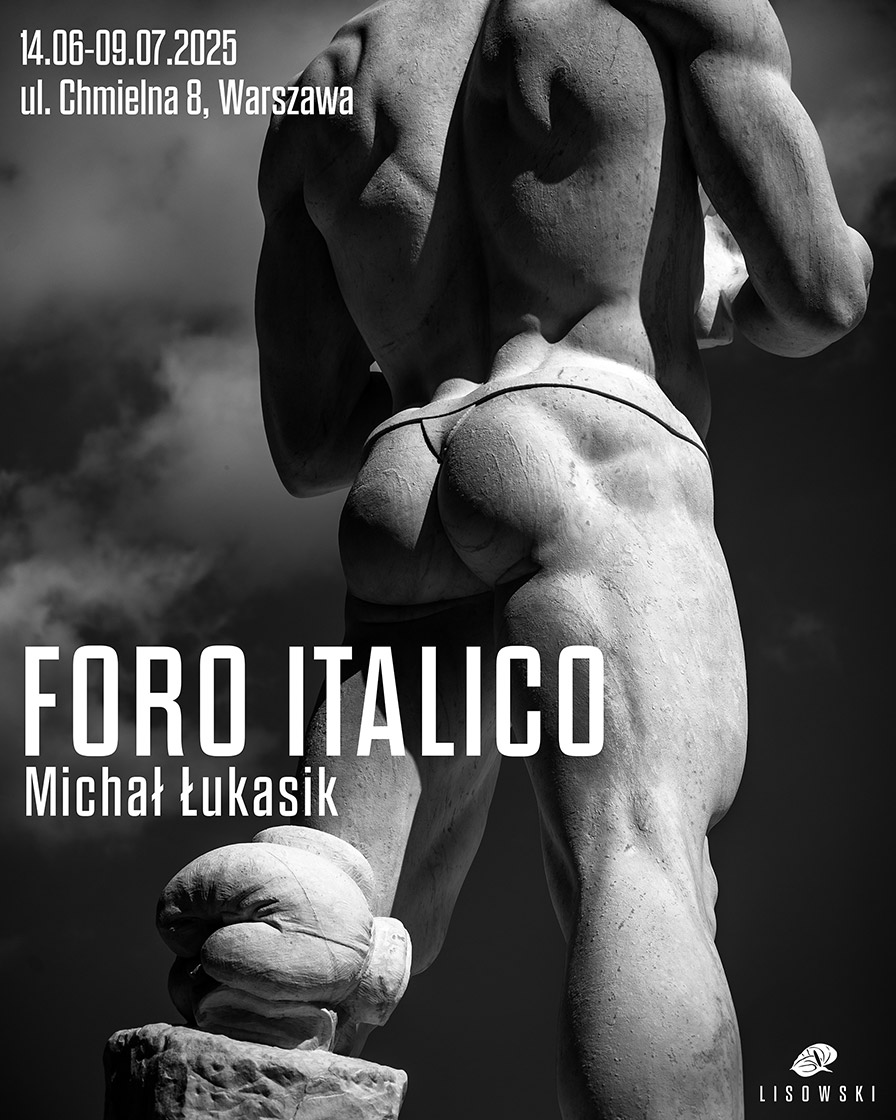
Foro Italico
Photography Exhibition at „Lisowski Gallery”
Curator: Cezary Lisowski
In what category can a boxer, a skier, a football player, an archer, and an athlete compete? The athletes photographed by Michał Łukasik compete not so much in strength, agility, or technique, but in beauty. All seem aware of their strengths. They strike poses that best showcase their athletic, muscular bodies. They pose for the camera and the viewer, but the photographer also captures the relationships between them—their sizing each other up. „Nice ass,” „nice biceps”—their mutual glances seem to convey. Łukasik portrays the monumental sculptures from the Stadio dei Marmi in Rome as if they were living athletes—or gym boys. He doesn’t reconstruct their fascist origins; he distances himself from the ideological past. He subjects these former tools of Italian propaganda to his own, homoerotic reinterpretation.
Rome’s Foro Italico (originally Foro Mussolini) sports complex was built between 1928 and 1938 at the initiative of the leader of the National Fascist Party, Gioventù del Littorio, as a youth training center and a manifestation of the power of the new civilization. Enrico Del Debbio’s design included the Academy of Physical Education, an indoor swimming pool, Mussolini’s private gym, and the Stadio dei Marmi, completed in 1932 and with a capacity of 5,000 people. The most distinctive element of the architecturally simple forum became the marble statues surrounding the stadium. Funded by Italian provinces and cities, the sculptures depict various sports disciplines. These figures, inspired by ancient models, represent one of the first manifestations of Fascist art’s fascination with classical heritage. Sculptors recreated almost all the sports practiced during the regime, particularly favoring „strong” athletes – hammer and stone throwers and discus throwers. Mussolini particularly valued boxing – it combined the qualities of strength and spectacle, perfect for propaganda purposes.
The selection of subjects was entrusted to Minister Renato Ricci, who ensured the project’s programmatic coherence. Twenty different artists created the sculptures, requiring complete visual uniformity. The sculpture designs were stylistically unified, and then sixty-four figures were carved in Carrara marble. Although athletes are portrayed, we do not see them in motion, training, or in action. The statues depict heroes of the new order rather than active athletes – monumental, beautiful, full of masculine strength and imperial gravity. Their athletic bodies were meant to be models of discipline and control – physical and ideological. But beneath the surface of this idealization lies a contradiction. The Fascist regime simultaneously condemned homosexuality and obsessively fetishized the male body. In the 1980s, gay camp culture reclaimed these sculptures as symbols of homoerotic irony. Photographers like Patrick Sarfati depicted the marble giants as objects of gay kitsch – seductive, theatrical, unreal. Łukasik’s work is part of this tradition. A photographer documenting the architecture of Italian modernism stumbles upon the Foro Italico by chance, but to portray the athletes, he returns several years later – fully aware of the time and circumstances of their creation. He aestheticizes the frames, transforming the vehicles of an ideology alien to us into a contemporary portrait of desire. The subjects of his works are meant to be isolated from their original context. But are they really so? Does the fact that the artist returns to Rome to portray them not demonstrate their power today? They still fascinate, are still admired – and so they still fulfill their function. They can still become tools of the new regime.


