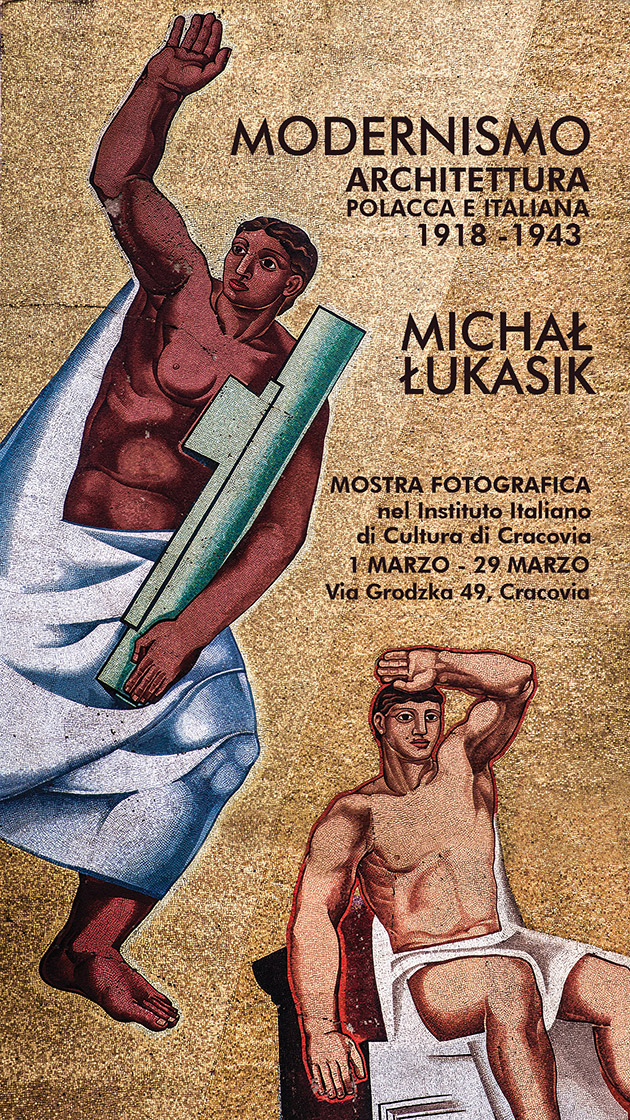
Modernism: Architecture of Poland and Italy 1918-1943 Kracow
Organizer: Institute of Italian Culture in Krakow
Photographer Michał Łukasik will take us on a journey through Polish-Italian modernism, showcasing both the differences and similarities between the architecture of these two countries.
The exhibition „Modernism: Architecture of Poland and Italy 1918-1943” premiered in May 2023 at the Italian Cultural Institute in Warsaw. In the same year, it was also presented at the international academic conference „Modernism in Europe – Modernism in Gdynia.” From March 1 to 29, 2024, Michał Łukasik’s photographs will be on display at the Italian Cultural Institute. Afterward, the exhibition will continue its journey to the Poznań University of Technology.
This series, comprising nearly 100 photographs, is the result of Michał Łukasik’s several-year journey tracing the modernist architecture of Poland and Italy. The exhibition will feature buildings such as: Rome, Naples, Milan, Venice, Bari, Warsaw, Krakow, Gdynia, Katowice, Łódź, and many other Polish and Italian cities. The photographs mainly feature Polish-Italian buildings of education, government, public utilities, culture, sports, and residential architecture from the Modernist period (1920s and 1930s).
The uniqueness of this architecture lies in its simplicity and elegance, as well as in its innovative construction methods. Modernism eschewed old forms and styles – rejecting opulence, excess decoration, and embellishment.
Modernism and Polish and Italian Architecture
It might seem that Italian and Polish Modernist architecture have nothing in common except the times in which they were created. There is much truth in this – after all, in each of these countries, Modernism took completely different forms and stemmed from completely different needs.
In the 1920s, Poland saw a shift toward the past – a country that had been absent from the world map for 123 years was trying to redefine its identity. A search for a new style also began, one that would, on the one hand, reference Poland’s rich history and, on the other, look to the future.
Interestingly, at the same time, Italy was completely negating the past. Italian Futurism focused on technological progress, the cult of youth, the disruption of the existing order, and the building of a „new Italy.”
However, by the late 1930s, numerous similarities between Italian and Polish architecture were already evident, as Michał Łukasik brilliantly captured in his photographs. The buildings are characterized by monumentality and geometric forms. An interesting sign of the times are the public buildings, which were intended to capture the imagination of citizens and emphasize the power of the then authorities and political system. These will also be on display at the exhibition at the Kraków Institute of Cultural and Industrial Architecture.
This text comes from an article by AD Architectural Digest Polska.


